
Tourism industry
What the site for an operation serving international clients could look like.
- Editorial:
- design
- Coherent:
- identity
We build custom sites that age well and represent the company behind them seriously. Every visual, technical and copy decision exists for a reason.

Visual references of the standard we apply to every project. Each example built from scratch — custom design, distinct identity, verified performance — to show the bar we can hit on your next site.
What the site for an operation serving international clients could look like.
What the site for a local business that needs to look serious could look like.
What the site for a studio that already built its brand on social could look like.
Editorial design built around destination visuals, clear hierarchy between services and routes, integrated contact form. A reference for how to represent with authority a company that operates with international travelers and needs to communicate professionalism from the first scroll.
No templates, no generic builders. Every visual decision exists for a concrete reason.
We don't fill sections with generic text. We write to communicate, not to impress.
Before delivery we measure with standard tools. We don't promise speed — we prove it.
The site works on phone before desktop. Accessibility is foundation, not afterthought.
The source code is handed over to the client upon completion of the monthly maintenance plan commitment. No hidden conditions, no third-party branding, no vendor lock-in.
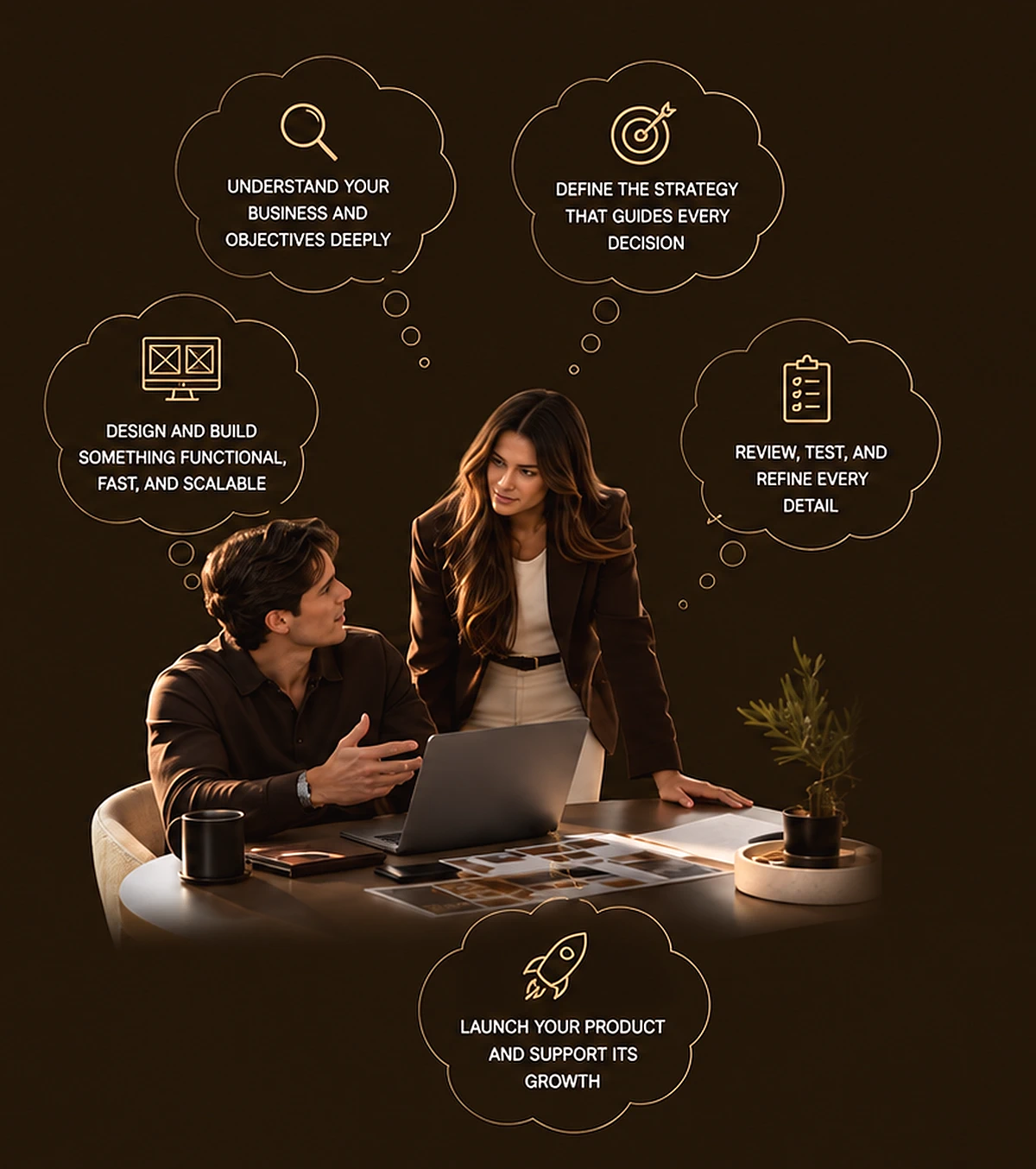
A 30-minute call, no commitment, to analyze the client's business, target audience, competitive context, and the message the site needs to convey. The goal isn't to sell a site: it's to determine whether the project fits what Starknot does well and what concrete problem the site has to solve.
Before writing a single line of code, the value proposition, section structure, information hierarchy, and base copy for each page are agreed. This document is signed as the project scope. Any later change is quoted separately, with no surprises mid-project.
Custom build from scratch, no templates. The client gets a live preview link from week one and reviews progress day by day. The phase includes a weekly sync call and a direct messaging channel for questions, with no waiting until the final delivery.
Once the site is complete, one formal revision round is included: copy, colors, section order, visual hierarchy, and final details. Changes are agreed in a single list, applied in one batch, and the final version is handed over ready to publish. Additional adjustments are quoted separately.
The site goes live in production with the domain configured, SSL certificate active, and measurement tools installed. The client receives technical documentation, admin access, and a short walkthrough to manage content. From here, the agreed monthly maintenance plan begins.
The timeline depends on the project's complexity tier. Tier 1 (a single-page site or a small-scope project) ships in 10 business days. Tier 2 (an institutional site or a medium-scope project) ships in 12 to 14 days. Tier 3 (an extensive project with custom sections or multi-language support) ships in 18 to 25 days. The work is delivered in phases, with visible deliverables every week, so there are no surprises at project close.
It isn't necessary. The first phase of the project is designed precisely to reach that definition: business diagnosis, value proposition, and section structure, all agreed in writing before a single line of code is written. If the client starts with a general idea, that idea is translated into a concrete scope that both parties sign off on at the start of the project.
Yes. Once the monthly maintenance plan commitment is fulfilled (six months from launch), the client receives the full repository (source code), the project data, infrastructure access, and the corresponding technical documentation. No third-party branding, no hidden conditions. If the client decides to end the relationship before the six months are met, an early-release fee agreed in the initial quote applies. Either way, the client retains full ownership of the site and takes all the material when migrating.
The project includes 30 days of post-launch support for functional fixes at no additional cost. Once that period is over, larger adjustments and new features are handled through the monthly maintenance plan, which is active from launch. If the client needs one-off work outside the plan's scope, that work can be contracted by the hour as needed.
Three channels of communication are kept open with the client during development: a weekly progress call with demonstrable advances, an asynchronous messaging channel (WhatsApp, Slack, or another agreed platform) for day-to-day questions, and a live preview link available from the first week. The client can follow project progress continuously, without having to wait until the final delivery.
Share the project context and we'll send back an initial proposal within 24 business hours.
Quote my project